

Efficient, safe & smart roadway lighting solutions
Street Lighting
Street lighting is the most visible piece of urban infrastructure most residents interact with every night. Done well, it makes a corridor feel safe, legible, and unhurried; done badly, it scatters glare across windows, washes out the night sky, and burns more energy than the road actually demands. Our roadway projects start from a photometric brief — the lighting class the corridor needs under EN 13201 — and work backwards through pole spacing, optic selection, and control strategy until the design hits the target with the smallest possible energy footprint.
How we approach street lighting.
The lighting problem
A residential collector, an arterial boulevard, and a coastal seafront all sit somewhere on the EN 13201 lighting-class spectrum (M1 through M6 for motorised traffic, P1 through P6 for pedestrian routes), and each class fixes a target for average road luminance, overall and longitudinal uniformity, threshold increment (TI, the glare metric), and surround ratio. The job of the design is to hit those numbers without overshoot — overshoot is wasted energy, light pollution into the upper hemisphere, and visual fatigue for residents whose bedrooms face the road.
The harder job is keeping the same scheme legible at 3 a.m. as it is at 8 p.m. Modern adaptive control — astro-clock dimming, traffic-density profiles, presence detection on quieter approaches — lets the same fixture run at full output during the evening peak and dim back to 50–60% in the small hours, where the lower class is still compliant.
Photometric and engineering considerations
Colour temperature on a public road typically lands between 3000K and 4000K. Cooler than 4000K reads harsh on Cyprus residential corridors and increases blue-light contribution to scattered sky-glow; warmer than 3000K loses contrast on white road markings. Optical control matters more than raw lumen output — a luminaire with a tight Type II distribution and good back-light/up-light/glare (BUG) rating delivers the same luminance with less spill than a flood-style head, and keeps the design defensible against IDA / dark-sky scrutiny.
Pole height, set-back, and spacing are where the photometric model meets the existing infrastructure. Most corridor retrofits inherit pole positions, so the design is constrained to choosing optics and tilt that work with the existing geometry — occasionally adding a head, more often replacing a sodium fitting one-for-one.
Energy and sustainability
LED retrofits of legacy HPS sodium installations typically cut electrical demand by 35–55% before any control strategy is added. Layered dimming on top of the LED swap takes the saving deeper, and in many municipal corridors the payback period sits comfortably inside the warranty window for the luminaires themselves.
Beyond kWh, the durable wins are maintenance: a 100,000-hour L80 LED engine running on a thermally conservative driver replaces the 4-year sodium relamping cycle that drove most municipal lighting maintenance budgets in the previous decade.
Standards and compliance
EN 13201 (the European photometric framework for road lighting) is the principal standard governing public roadway design across the EU and is referenced in most Cyprus municipal tender documents. CIE 115 covers motorised traffic categories; CIE 136 covers urban areas. Where local authorities have adopted dark-sky guidance, BUG-rated luminaires keep schemes within the U0–U1 upper-hemisphere envelope expected of low-impact installations.
What every brief asks us.
- EN 13201 lighting-class selection driven by traffic and pedestrian volumes
- BUG-rated optics to constrain back-light, up-light, and glare
- Adaptive control: astro-clock dimming, traffic-aware profiles, off-peak setback
- Colour temperature 3000–4000K balanced against contrast and sky-glow
- Pole geometry constrained by the existing civil infrastructure
- L80 lumen-maintenance modelling against the warrantied service life
Related case studies.
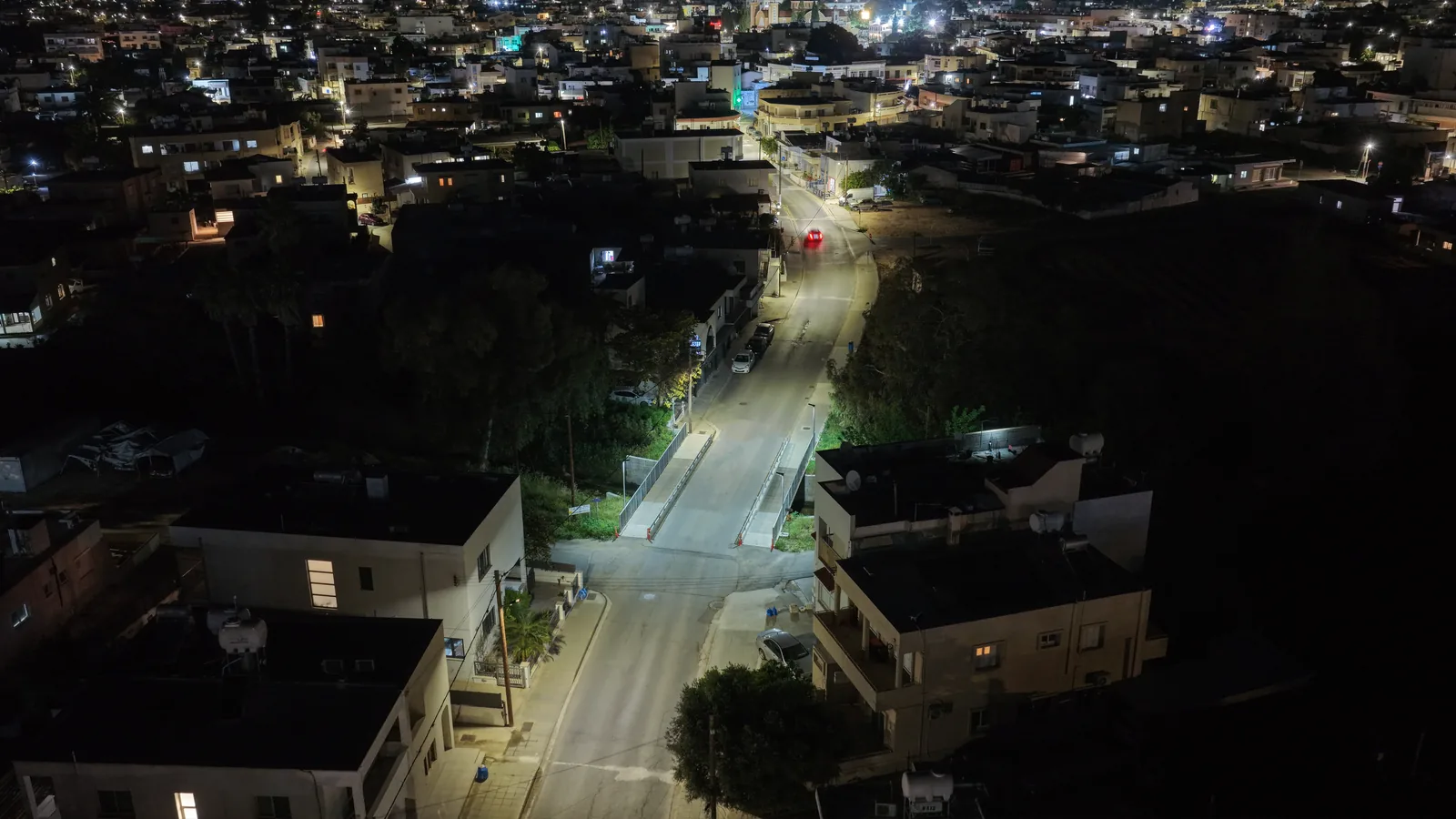

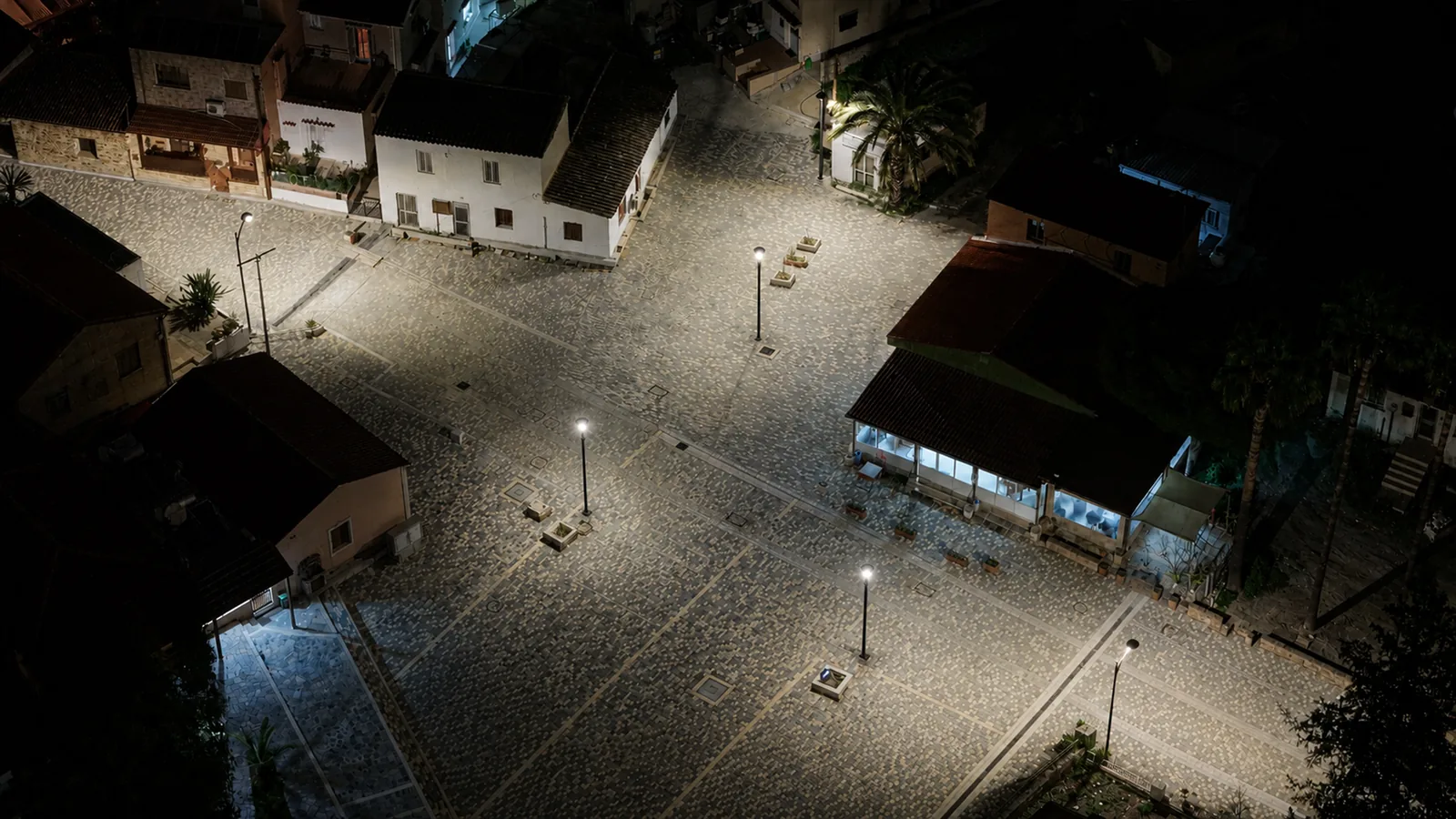
Common questions.
- What lighting class do most Cyprus municipal roads fall under?
- Most arterial corridors fall under EN 13201 ME3 or ME4, with ME2 reserved for high-volume primary routes and ME5 for quieter residential collectors. The exact class is set in the municipal brief and depends on traffic flow, conflict density, and the surrounding land use.
- How much energy can a sodium-to-LED retrofit save?
- Before any control strategy is added, swapping high-pressure sodium heads for modern LED engines typically cuts electrical demand by 35–55%. Adding adaptive dimming on top — astro-clock setback in the small hours, traffic-aware profiles on busier corridors — pushes the saving past 50% on most schemes.
- What does dark-sky compliance mean for street lighting?
- It means selecting optics that put light on the road, not into the sky. The IES BUG rating system grades a luminaire's back-light, up-light, and glare; dark-sky-friendly fixtures sit in the U0 or U1 up-light category and use sharp cut-off optics that keep light below the horizontal.


